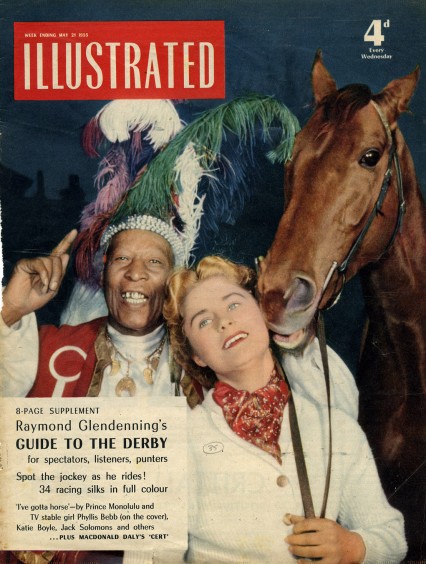
The fabulous racing tipster Prince Monolulu with 'TV stable girl' Phyllis Bebb.
One of the best-known and flamboyant London showmen who pitched up at Petticoat Lane market every Sunday wasn’t Alan Sugar, who started his business career as a stall-holder at the famous East End market, but a black racing-tipster who grandly called himself Ras Prince Monolulu. In fact, from the 1920s until he died in 1965, and unless Paul Robeson was visiting the country, he was probably the most famous black person in Britain.
Petticoat Lane market has, in one form or another, existed in the East End for hundreds of years. The actual road that was called Petticoat Lane had its name changed to Middlesex Street in the 1830s – the word ‘petticoat’ was deemed a little unsavoury for the young Queen Victoria – but the original name has stuck to mean the general area.
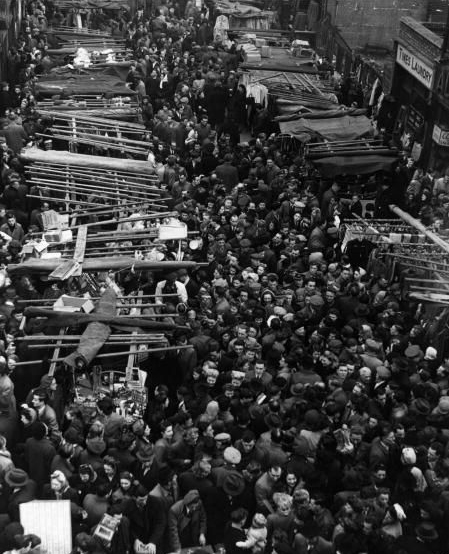
Petticoat Lane Market in 1946
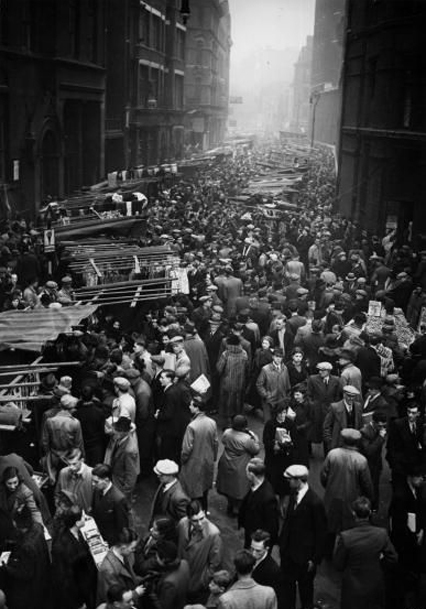
Petticoat Lane, 1938
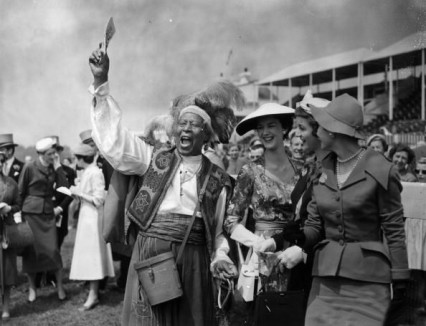
Monolulu on Derby day in 1954
Monolulu usually wore an ostentatious head-dress of ostrich feathers, a multi-coloured cloak and gaiters, a huge scarf wrapped around his waist and was hardly ever without his huge shooting stick-cum-umbrella. Of course anybody who was considered remotely amusing in those days had to have a catch-phrase and Monolulu’s, heard by everyone at Petticoat Lane and race-courses around the country, was:
“I Gotta Horse, I Gotta Horse’.
Monolulu was born Peter Carl McKay in 1881 and was originally from an island called St Croix, now part of the US Virgin Islands in the West Indies. He arrived in Britain in 1902 and after a year of mostly menial work he managed to join the chorus of the first all-black West End musical show called In Dahomey.
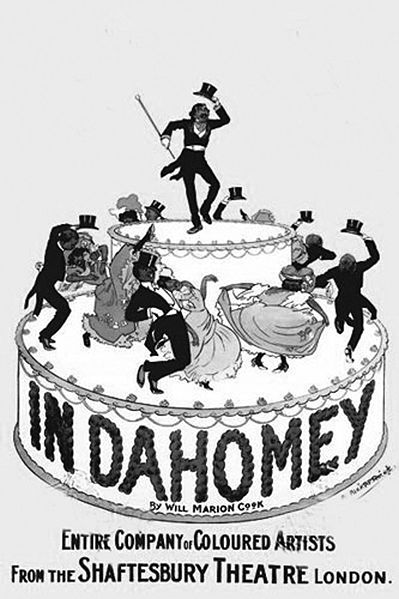
In Dahomey was initially staged on Broadway to limited success and after just 53 performances it was transferred to London’s Shaftesbury Theatre. The British public had literally seen nothing like it and the show became a huge sensation. The success was capped by a command performance celebrating the birthday of the Prince of Wales at Buckingham Palace, where it was heralded as “the most popular musical show in London.”
The musical featured an elaborate version of the African-American minstrel dance called the ‘Cakewalk’ and featured several hit songs as well as making stars in London of the principal actors.
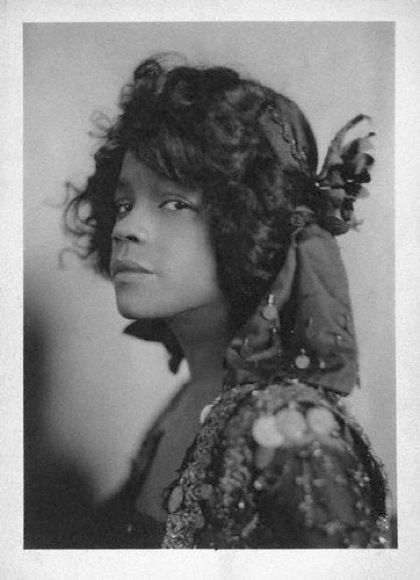
Aida Overton Walker. Photograph by Cavendish Morton in London 1903
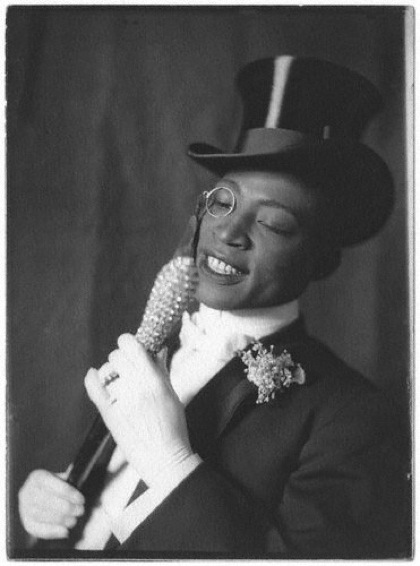
George W Walker in 'In Dahomey' 1903
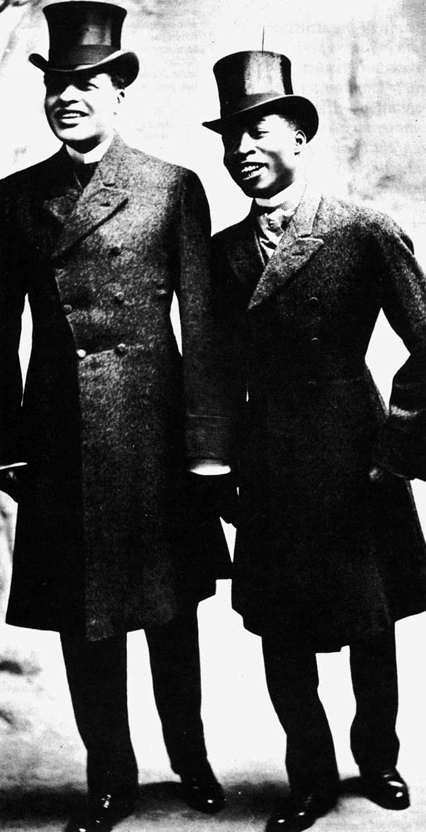
George W. Walker and Bert A. Williams
After In Dahomey came to an end there wasn’t much work for black musical actors in London (to say the least) and Monolulu travelled Europe as a fortune teller, violinist, singer, lion tamer and even a ‘cannibal’ in a travelling roadshow. He was in Germany when the first world war broke out and he found himself in a German Internment camp called Ruhleben (which, incidentally was a former race course) near Berlin for the duration of the war.
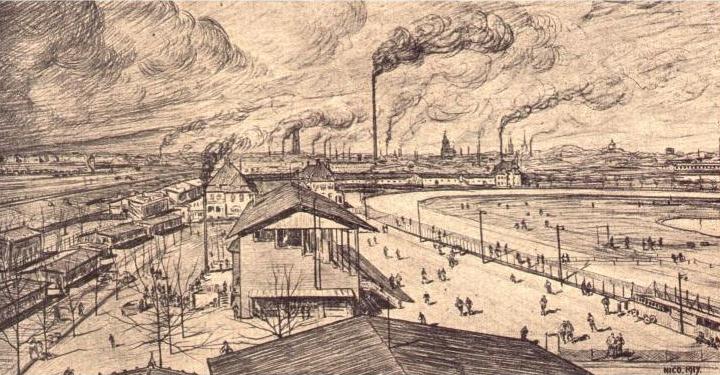
The Ruhleben Internment camp during the First world war.
After he returned to England, he began work for an Irish tipster but quickly went solo and took to shouting “I gotta horse” after seeing the religious revivalist Gypsy Daniels shouting “I’ve got heaven” to attract his crowds.
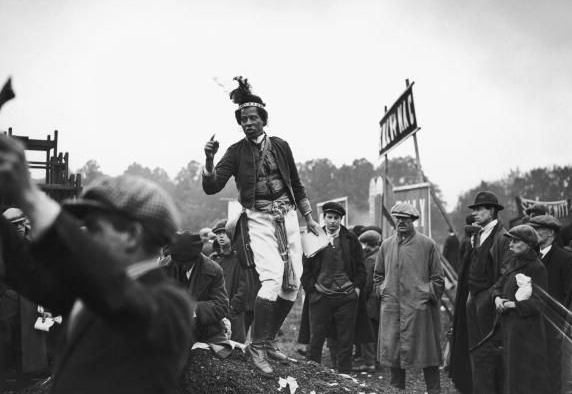
An almost Hendrixian Monolulu at Epsom on Derby day 1923
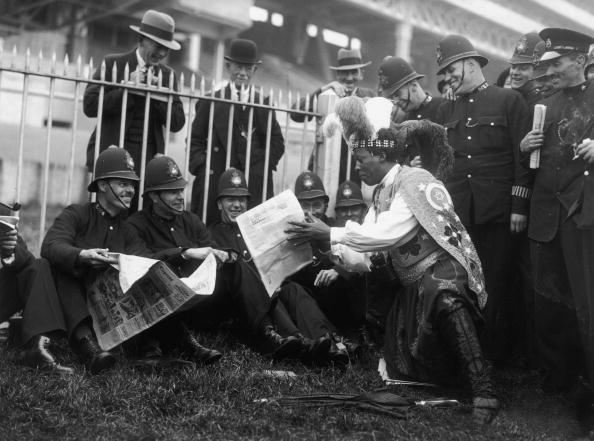
Epsom, 1932
In 1920 Monolulu reputedly won £8,000 on the Derby when he put all his money on an unfancied horse called Spion Kop. It was a vast sum of money at the time and from that moment on he became a tipster for ever more. When anyone bought a tip from him (at Epsom at the height of his fame he would charge ten shillings) he’d hand over a sealed envelope inside of which was the name of the horse written with careful handwriting on a piece of paper. He’d lean over to the punter and whisper:
“If you tell anyone, the horse will lose”.
It seemed that someone always told someone because Monolulu’s horse nearly always lost. Although no one ever complained.
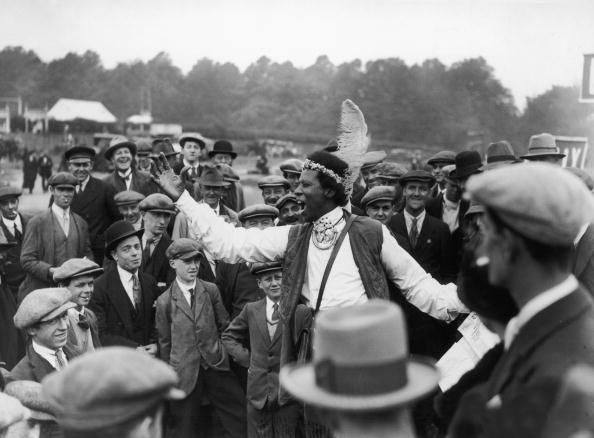
Prince Monolulu at the Epsom races in 1927
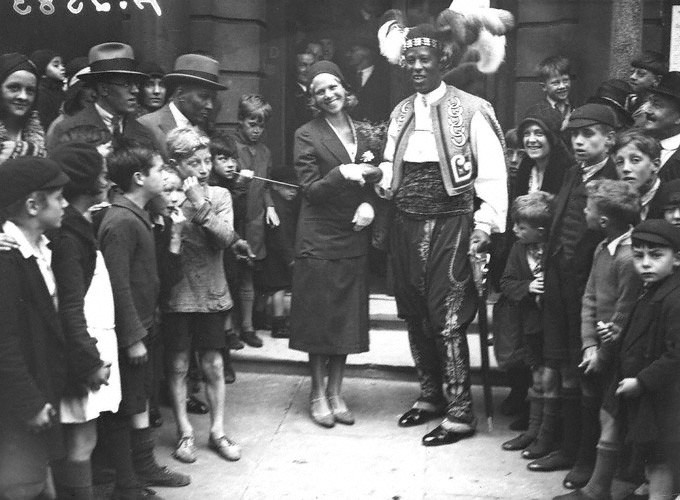
Ras Prince Monolulu after his marriage to the actress Nellie Adkins in 1931
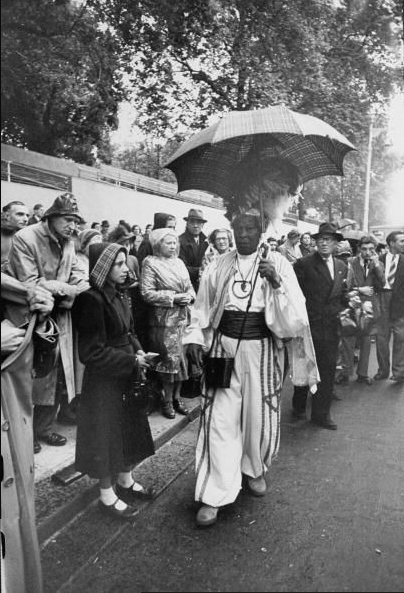
Monolulu at the Queen's coronation 1953
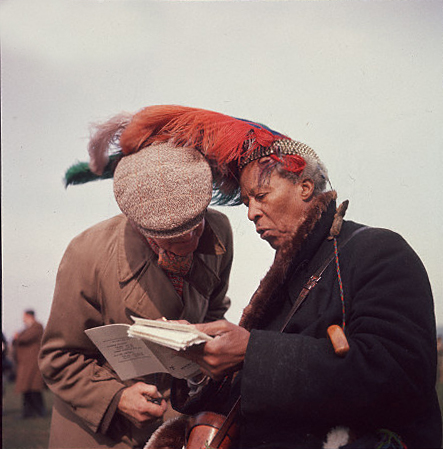
Monolulu in 1956
From the 1930s any British film that featured a race course would include Monolulu playing himself. Eventually he appeared in over ten films with his last appearance being in a Billy Fury vehicle called, fittingly, I’ve Gotta Horse.
On Valentine’s day in 1965 Jeffrey Bernard, who was working as a racing journalist at the time, visited an ill Monolulu in Middlesex hospital wanting an interview. Bernard had brought with him a box of Black Magic chocolates and offered the famous tipster a ‘strawberry cream’. Unfortunately, Monolulu started to fatally choke on the chocolate. Bernard backed out of the ward bidding farewell.
Monolulu lived for a lot of his life in Fitzrovia and there was once a pub named after him called Prince Monolulu at 28 Maple Street. Unfortunately a few years ago someone decided that a three-level cocktail bar called Potion was a much better idea.
Here’s an example of Prince Monolulu’s patter recorded in 1933.
Prince Monolulu – I Gotta Horse

Tags: betting, East End, horses, Jeffrey Bernard, markets, races
I’m pretty certain the Prince Monolulu pub was still there in 1992/3 – I was living in Ramsay Hall of residence, also on Maple Street, and seem to remember it. Not that I had any inkling of its namesake. Thank you for the backstory – again.
thanks
you are a genius
the cake walk clip sent me onto youtube and i found some treats
i have worked with hip hop dancers for the last 10 years and done several shows involving a fusion of hip hop styles and celebrating the history of hip hop
BUT REAL live film clips FABULOUS
An amazing story beautifully told. And, as always, I love the photos. In the colour pic from 1959, Monululu looks a lot like Nelson Mandela.
hi excellent material, both images and text.i give talks to groups about this amazing man who visited great yarmouth and its racecourse regularly.many stories exist about him and amongst the artefacts i have there is one of his original tip sheets
many thanx
dave
There were times I thought I had dreamed about Prince Monolulu because he seems such an unlikely character. So thank you for confirming his existence in your brilliant post. You see, I really did come across him a couple of times in my childhood.
As a Londoner, I think your blog is splendid.
Another magnificent story. What a great TV drama this would make, fatal strawberry cream and all. Please consider yourself saluted.
That’s a great website and a wonderful, well-written story. I’m writing an article about Petticoat Market for Suite101.com and found this information very useful. Thanks.
I am now 74 years old but I remember being taken to Petticoat Lane by my mother as a young child. We saw Prince Monolulu many times and on one ocassion, he said to me, “I gotta horse, do you wanna horse?” I replied “yes”. I was bitterly disappointed at not being able to take a horse home with me. Prince Monolulu is one of my childhood memories.
A great source of information. Prince Monolulu’s jackets have been chosen by Newmarket’s National Horseracing Museum as their contribution to the BBC’s A History of the World project. There’s a feature, audio of the great man and a picture gallery here:
http://news.bbc.co.uk/local/suffolk/hi/people_and_places/history/newsid_8489000/8489857.stm
I remember the prince,he livedin the same building as my grandad,on the 1st. floor, in cleveland street,that was the early 1950′s,Iwas very young but we used to speak to each other ,he was always in his colourful outfits.
I LIVED AT 83/85 CLEVELAND ST FROM 1950 TO ABOUT 1964 WE LIVED ON THE FIRST FLOOR AND PRINCE MONOLULU LIVED DOWN STAIRS HE ALWAYS SAID ONE DAY I WOULD BE PRIME MINESTER HI CAROLE WHO WAS YOUR GRANDAD.
Hi Peter,very surprised to see your post.My grandad was John Edward Shea,he had fine thin straight hair slim build and had a moustache , he died in 1954,but just before that he went to live at Luxbourgh lodge [the old marylebone workhouse],my mum was Lily,we lived at Euston.You must be getting on a bit rememberig that…C.W.
As a 10yr old in 1960 I met Prince Monolulu when he came to open a refurbished pub called The Three Horse Shoes in Coventry. Themed lounge being racing. Myself and the publicans daughter Sheila Quinney were photographed with him for the Coventry Evening Telegraph. What a character.
Today is the second day of the Listowel (Co. Kerry) racing festival (7 days). One of the highlights for us at Listowel Races as teenagers back in the 1950s was the arrival in town of Prince Monolulu. Apart from his colourful dress and personality it was the first time most of us would have seen a black or coloured man.
Many years ago a very well known short story from Listowel, the late Bryan McMahon wrote a ballad in honour of the race week, sung to the air of Master Mc Grath or Erin Go Brath one of the many verses went,
“They came from Castleisland, they came from Tralee,
And a black- looking devil, he came from Fiji,
We’d a Dutchman, a German, a Chink and a Pole,
Sure ’twas more like Geneva than lovely Listowel.
Mim Scala I swear this is true The Prince would occasionally come to The North end Road Market in Fulham and would inevitably wind up in Scala’s after selling tips written on brown Paper. 1953 I came home from school and there he was in the kitchen with my dad he had his feathers on and everything. He told us to back Pinza in the Derby as Mr. Sassoon was a personnel Friend of his and it was a cert . The whole market backed it for a famous win
I cant remember the price but my Half crown was on XX Mim
Fascinating! And Mr. Woodger, great photos in the URL you posted – love the one of Prince Monolulu with a group of Pearly Queens! I’d love to see a post about the Pearlies here…I’m American, and first heard of them from a family friend (sadly, long dead now) who had been a vice cop in London before WWII and then served in the RAF as a fighter pilot and then a bomber pilot. After the war he immigrated to Canada and then the U.S. He had incredible stories. I wish I’d recorded him, but this blog has given me far more insight into the world he grew up in. Kudos.
My Mum is 104 and although blind now, still has a fantastic memory of times past. We were chatting about horse-racing and she referred to Prince Monolulu and remembered his catch-phrase “I gotta horse”. “In Dahomey” was before her time but when she was 19 she remembers going to see a show “Blackbirds” up the West End where all the cast was black. She remembers still how fantastic the show was and how the singing and dancing was amazing. They were still doing the Cakewalk when she was in her teens, and of course, also the Charleston and the Black Bottom. Mum’s local market was Chapel Street but her evenings were spent dancing “Up West”. Nothing changes, eh?
Prince Monolulu pops up (very) briefly in this short doc about London markets, narrated by Sid James. It’s about 2:35 mins in, don’t blink or you’ll miss it!
http://www.youtube.com/watch?v=YMHjsmCjL78
I remember Prince Monolulu also coming to the East Lane Market, in South London, when I was a child in the early 1950′s. If I remember correctly, he occasionally called at our prefab to take me, and my younger sister, to stand with him at the opposite corner to East Lane and Minnow Street, whilst he sold his betting tips. A great character. I asked my mother about it, but she doesn’t remember!!
I remember seeing Prince Monolulu on TV in the 50′s. It has often occured to me that he would done rather well at the Battle of Bosworth, when Richard 3rd called out , “A horse, a horse, my kingdom for a horse!” Then along comes Monolulu with his catchphrase, “I gotta horse!” Thanks for an interesting article. JK.
This is a fascinating website, thank you for the wonderful memories. My great-grandparents were neighbours of Prince Monolulu in the late 1940s, they lived in Netley Street off the Hampstead Road.
Super website. Great to read about the character whose face and costumes I could remember from childhood but whose name I’d completely forgotten. All I could remember was the flamboyant black man shouting “I gotta horse”. I couldn’t even remember where I’d seen him but it all came back to me when i saw your article on Petticoat Lane. Now I can remember it all. Having been brought up in Stoke Newington and now living in NZ I miss all the history of London. Thanks for the memories.
My husband, Martin says he was blessed by Prince Monolulu as a child….lucky him…
He is now disappointed to read that he was a fake prince !
I remember my father took me to Newmarket Races in the early 50′s probably around 1952 and we saw Prince Monolulu dressed in all his finery with a lions claw hanging around his neck and his famous plume on his head he actually called out “I gotta horse as we stood there. I will never forget that.
Loved the website. I still remember seeing Prince Monolulu at Petticoat Lane when I was a young boy living in Wapping. Thanks from Colorado, USA for the work to locate and preserve the information.
I worked in London during the war and remember Prince Monolulu at Speakers Corner in Hyde Park. I am 87, and he is one of my strongest memories. Enjoyed the photos, loved the film clip of Petticost Lane. Mant thanks.
Prince Ras Monolulu was my godfather (I’m sure he had a lot of other godchildren). I have a picture of him somewhere at my Christening – with all the feathers, of course!
In the 1950s we went as a family to Towcester races on Easter Monday.
Uncle Fred bought a tip off the prince for ten bob after hearing his call “I got a horse”. I don’t think it won but I well remember the day out.
My Nan and Great Aunt used to see the Prince sometimes when they visited their Nan Sarah Clara Green in Drummond Cresent I am guessing during the 1930s. Their Nan liked a flutter. They said the Prince was like the pied piper with a bunch of kids always around him following him down the street. Thanks for this insight into the man. My Great Auntie Vi still talks about him.
My family lived at 141 Cleveland Street from 1945 to 1961. I was one of the kids who used to follow Prince Monolulu along the street. We were dazzled by his colourful costume and feathered headdress. As Peter and Julia say above, he was like the Pied Piper. We would beg him to hold our hand and tell us our fortune, calling out “what will I be, what will I be?”. When I was five years old one day I managed to grab his hand and ask him. He looked at me seriously for a second or two and said “young lady you will be a secretary”. As a five year old, I had no idea what that was, but guess what, he was spot on! My uncle George who lived at 116 remembers before the War he would stand outside the George & Dragon Pub in Cleveland Street with sweets in the folds of his baggy trousers and throw them out to all the kids gathered around him. He did not own many material things and slept on the floor on a straw mattress at 83 Cleveland street. He put most of his winnings into buying gold including gold teeth and when he was down on his luck he would simply pawn them and start again. What a character !
I heard the story about him choking to death in hospital on a sweet. So sad. He was a memorable part of my childhood. I can still feel the coolness of his large strong hand holding mine even to this day. I can still hear his charismatic soft voice. He was the first black man I ever saw. That was in about 1954. We all still talk about him to this day.
I am 89 left UK at age 22′ loved Hyde Park Corner, interesting to read the life story of the Prince. He was indeed a colorful character. Been back several times, born in London, still a cockney to the core. Fate brought to where I am now.
Comment as above
Miss my hometown. Childhood memories abound.
My 85year old mother still makes prince monolulu suntan lotion, he gave her grandfather the receipt for her to use when she was 6years old. Olive oil and vinegar!
My family were street corner Bookies and had pitches at both ends of the lane
My uncle Lew who Monolulu bet with always said he almost never won not even breaking even most weeks.
What he did do with his tips was mainly stay to races with a small field and tip every horse in the race E/W so in a ten horse race he had one winner and two place winners.
In big races he did read form but mainly stayed with the first four in the betting
I am now almost 80 but I rmember him going down Bruce Grove shouting ‘I’ve gotta horse’ He was part of Tottenham. When I was small my mum told me to touch him for luck. When I was older she was scandalised to find I was actually speaking to him. How times Have changed.
Is Tina Maskell one of the Tottenham Maskells?
i remember him outside the gates at newmarket races i use to think what a fascinating person pity there are not more people like prince monolulu about
I find Prince Monolulu so fascinating and I am researching his life. I have purchased a book from the U.S.A and inside as I opened fell out one of his tips
and on it is 23.v.57 London, then mr and mrseaton
the message reads many thanks for your Christmas dinner god bless your family and grand childrens please answer ifyou please send me the address of the bugler/the Englishman. on one edge it says a little bit of dear old London
on the other edge it gives tips of mounne 11 derby and rose royal oaks I believe. Has any one any ideas. Also the book was SEX AND RACE WITH A MESSAGE TO GARY AND RANDY DATED 3/3/57 CAN ANYONE THROW ANY LIGHT ON WHO THESE PEOPLE COULD BE PLEASE. MY EMAI IS goldenlady2@sky.com if anyone has any info or items/stories they wish to share. For I am writing a book on his life and I am doing a memories chapter. Many thanks Frank Lannon
I grew up in the East End of London from 1949 to 1970 and I only saw Prince Monolulu once, on the London Underground (Central Line). He definitely stood out from the crowd in his feathers and costume. Large parts of the old East End have now been demolished, whole streets including the house I grew up in, were flattened to make way for tower blocks.Prince Monolulu was part of old London, we shall not see his like again.