Archive for the ‘Soho’ Category

Berwick Street, and the rivals in love – Jessie Matthews and Evelyn Laye

Sunday, April 5th, 2009

“The woman Matthews writes letters which show her to be a person of an odious mind.” – Sir Maurice Hill

Jessie Matthews as a boy

Jessie Matthews as a boy in 'First A Girl'.

Once upon a time it was fair to say that Jessie Matthews was one of the most famous women in the country. Before the Second World War she was easily Britain’s biggest film star by far. Today, except for the eldest amongst us and a blue plaque on the wall of the Blue Post pub on the corner of Berwick Street, she is now almost completely forgotten.

She was born on March 11 in 1907, in a small, cramped and overcrowded flat above a Butcher’s shop in Soho’s Berwick Street. Matthews was the sixth of eleven children and her father was a costermonger in the market for which Berwick Street is still famous. Twenty years later, with elocution lessons having removed her natural cockney accent, the saucer-eyed actress took the West End by storm.

berwick-street-market-1933

berwick-street-market-furs-1929

Early 20th century views of Berwick Street

Jessie aged 16 appearing in the Music Box revue

Jessie aged 16 appearing in the Music Box revue

In 1927, already a star, Jessie Matthews was booked to perform in the 29 year old Noel Coward’s new revue This Year of Grace. Her co-star in the production was a bespectacled and short comic actor called Sonnie Hale who was married to the regally beautiful blonde actress called Evelyn Laye. Laye was seven years older than Matthews and was an extraordinarily popular West End singer and actress at the time.

Already a West End star, the 17 year old Evelyn Laye 1917

Already a West End star, the 17 year old Evelyn Laye in 1917

Evelyn Laye

Evelyn Laye

Evelyn Laye and Sonny Hale at their wedding in 1926

Evelyn Laye and Sonny Hale at their wedding in 1926

Evelyn Laye held a small supper party, at the end of 1927, for her close friends at Soho’s recently opened Gargoyle Club. The guests included the actress Ruby Miller and the young actor Frank Lawton. After one of the rehearsals for This Year of Grace her husband brought along his young, pretty and dangerously charming co-star (the Sunday Times’ theatre critic James Agate would later describe Matthews as ‘the rogue in porcelain’).

Matthews was already married at this time, unfortunately to a womanising debt-ridden actor called Henry Lytton Junior. She had married Lytton, who was from a famous theatrical family to seek stability in a life which must have seemed completely unreal to her at her young age. His family also offered social advantages to the young actress that her working-class upbringing would have lacked.

Their wedding occured only eighteen months after she had been initially courted and then raped at the age of sixteen by a louche, handsome Argentinean friend of the Prince of Wales called Jorge Ferrara. He must appeared utterly sophisticated and seemingly from another world when the extremely innocent Matthews met him on a ship to New York where she was to appear on Broadway as an understudy for Gertrude Lawrence.

When Jessie returned to London she had a secret and illegal abortion from which she never really recovered psychologically (and maybe physically as she suffered from miscarriages though out her life). She made fourteen films during the thirties and maybe had as many breakdowns. She later wrote in her autobiography; “All my life I have been frightened.”

Unfortunately the stability she sought in her marriage started to crumble after just eight months when Lytton, who had not only had been sleeping with chorus girls behind Matthews’ back (indeed he’d been having an affair with one girl in particular from the very week they had been married), had started to become increasingly envious of her growing success.

jessie-and-lytton

Jessie and Henry Lytton Jnr performing together in Charlot's Revue in 1925, two months before they married.

At the Gargoyle club, situated in Meard Street – a stone’s throw from Berwick Street – a friendly Laye (at least on the surface) genially greeted Matthews when she arrived with her husband. The two women would have previously met at theatrical parties but they didn’t know each other well and sitting at the table facing each other, observers of the two well-known actresses would have noted how they contrasted in looks and temperament.

The blue-eyed blonde Laye was tall, cool and sophisticated but maybe slightly aloof (Sonnie would later say that she was sexually frigid), although certainly not classically beautiful, Matthews’ brown pageboy fringe and huge sparkling eyes contributed to a sexual attractiveness and zest for life that most men found utterly irresistible.

They both had one thing in common, however, and that was their love for, it has to be said less than Greek, Sonnie Hale.

The starlet Jessie Matthews in 1927

The 20 year old starlet Jessie Matthews in 1927

Sonnie Hale in 1926, the year he married Evelyn Laye

The 'less than Greek' Sonnie Hale in 1926, the year he married Evelyn Laye

Jessie in 1926

Jessie in 1926

Early in the new year of 2008 Evelyn Laye had travelled up to Manchester where Coward’s This Year of Grace was previewing and on arriving she accidentally caught her husband and Jessie holding hands. The co-stars rather to0 quickly and expeditiously unclasped the hands on seeing her. Laye pretending to joke, asked whether they were in love with each other, to which they laughingly assured her that the idea was absurd and foolish. It was, as Sonnie pointed out, less than a month to their second anniversary.

Although genuinely upset and confused, Jessie and Sonnie were lying. They had been lovers for several weeks.

This Year of Grace opened to rave reviews both for Jessie and for the writer Noel Coward (it resurrected his career). The Sunday Express ironically ranked Jessie Matthews with Evelyn Laye as ‘the brightest female stars on our English light musical stage’. This would have really rankled Laye, who saw herself as London’s reigning stage beauty, and it only got worse when Room With A Veiw a song from This Year of Grace became a huge hit that summer and it would have been played on every radio show and in every night club.

A few weeks later Evelyn Laye found passionate and rather explicitly detailed love letters, albeit in an ill-educated childish scrawl, from Jessie to her husband. After confronting Hale with them, he admitted his love with Matthews, and it wasn’t long before Laye moved out of the Hale home in Linden Gardens and moved into a small flat in South Audley Street in Mayfair.

Evelyn appearing in Ziegfeld's production of Bitter Sweet in 1930

Evelyn appearing in Ziegfeld's production of Bitter Sweet in 1930

evelyn-laye-august-1932

On the 2nd June 1930 the decree nisi granted, in absence to Jessie Matthews against Henry Lytton, was made absolute. Five weeks later in the Royal Courts of Justice in the Strand, Evelyn Laye’s divorce petition came before Sir Maurice Hill – a judge who was close to retirement but particularly averse, in almost a prehistoric fashion, to divorce.

Evelyn Laye wasn’t present as she was filming One Heavenly Night in Hollywood, however, and against all advice, Jessie Matthews decided to attend. She realised her mistake when her letters to Sonnie were read out in open court:

‘My Darling, I want you and need you badly, all of you, and for a very long time. I am lying here, waiting for you to possess me. The dear little boobs, which you love so much, are waiting for you also.’

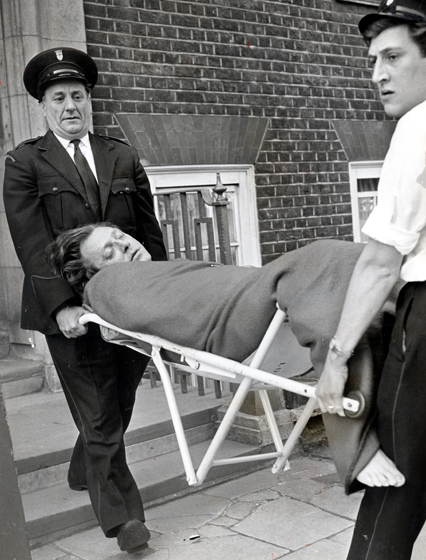
At one point Jessie Matthews fainted during the reading of one letter and had to be helped outside but this didn’t help with the brutal severity of the judge’s final comments:

‘It is quite clear that the husband admits himself to be a cad, and nobody will quarrel with that, and the woman Matthews writes letters which show her to be a person of an odious mind.’

Evelyn Laye in One Heavenly Night 1930

Evelyn Laye in One Heavenly Night 1930

Evelyn Laye and John Boles in One Heavenly Night

Evelyn Laye and John Boles in One Heavenly Night

Evelyn Laye in 1933

Evelyn Laye in 1933

Jessie and Sonnie Hale on their wedding day.

Jessie and Sonnie Hale on their wedding day.

Jessie Matthews and Evelyn Laye, not surprisingly, hardly spoke to each other again – quite difficult, one suspects, in the relatively small world in which they lived and worked. In January 1931 Sonnie Hale and Jessie Matthews married at Hampstead registry office.

After all the scandal that the relationship had caused it wasn’t a particularly long and happy marriage and Jessie had many affairs including Salvador Dali during a holiday in Barcelona, and the bisexual actors Tyrone Power and Danny Kaye.

It was while she was performing with Kaye in a disastrous Broadway musical that Matthews had the worst of her breakdowns and was admitted to a psychiatric hospital. She was diagnosed with chronic paranoid schizophrenia and the hospital reported to Hale that she was ‘on the edge of madness’.

When Jessie returned to Britain she found out that Hale had fallen in love with the nanny who had been employed to look after their adoptive daughter and a year later they were divorced.

Jessie Matthews in a blonde wig appearing in Evergreen 1930

Jessie Matthews in a blonde wig appearing in Evergreen 1930

jessiematthewsdm_468x444

jessie-matthews-as-young-girl

Jessie Matthews never retained the popularity of her pre-war years. Her style of dancing and singing appeared old fashioned not helped by the cut-glass accent caused from her elocution lessons from when she was a teenager.

By 1970, when she was awarded an OBE, she had become, if not fat, slightly more rotund and matronly than in her lithe graceful days as an actress and dancer during the twenties and thirties. Around this time Evelyn Laye, seeing her perform at an all-star charity gala, said waspishly:

‘Oh look, the dear little boobs have become apple dumplings.’

Evelyn Laye married again in 1936 to the handsome young actor Frank Lawton who ironically had been at the late supper at the Gargoyle club where Laye and Matthews had first formerly met. They were happily married until Lawton’s death in 1969 and Evelyn continued to work in the theatre until well into her nineties.

Evelyn Laye and her second husband Frank Lawton

Evelyn Laye and her second husband Frank Lawton

Evelyn Laye in One Heavenly Night

Jessie Matthews in Evergreen

Jessie Matthews in First a Girl

A lot of the information for this post has come from the biography of Jessie Matthews by Michael Thornton which although out of print can be found here.

Two songs made famous by Jessie Matthews sang by two of her contemporaries:

Noel Coward – Room With A View

Al Bowlly – Over My Shoulder

Jessie Matthews DVDs and music can be bought here
Evelyn Laye music can be bought here, alas copies of her films seem to be short on the ground, although apparently her acting style, like Jessie’s singing, has dated somewhat. It’s safe to say that her extraordinary beauty certainly hasn’t.

Share

Soho and the 2 i’s coffee bar

Thursday, July 3rd, 2008

“Soho is a place where all the things they say happen, do” – Colin Macinnes

The 2 i's Coffee Bar in Old Compton Street

The 2 i's Coffee Bar in Old Compton Street

In 1953 the Italian actress Gina Lollobrigida opened the Moka coffee bar at 29 Frith Street in Soho which provided London with its first Gaggia expresso coffee machine. Some have argued that the simple opening of this West End coffee bar was the early morning double-expresso that London needed to kick-start its way out of the grey post-war depression, setting itself up to become the world’s trendiest city in only a decade’s time.

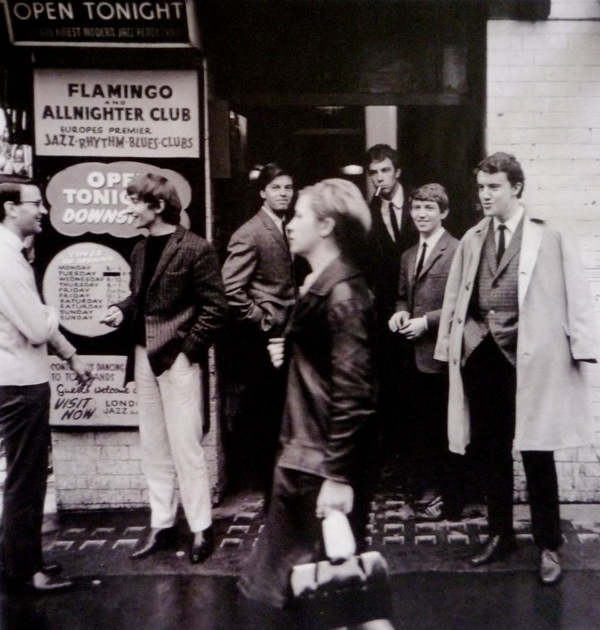
Quickly other coffee bars sprung up around Soho, often providing live music, these included the Top Ten in Berwick Street and the Heaven and Hell bar in Old Compton Street, but the most famous of all, and next door to the Heaven and Hell, was the 2 i’s at number 59.

Almost over night young people, who now for the first time were starting to be known as ‘teen-agers’ had somewhere to go they could call their own. The coffee shops were unlicensed and there was nothing to stop teenagers coming to Soho to listen to music, live, or on the jukebox. If you were young, Soho was suddenly the place to be.

Gina Lollobrigida in 1953

Gina Lollobrigida in 1953

The Moka coffee bar in 1953, seemingly offering a free electric shave

The Moka coffee bar in 1953, seemingly offering a free electric shave

Skiffle band playing on an old bomb site in Soho 1956

Skiffle band playing on an old bomb site in Soho 1956

'teen-agers' in Soho 1956

'teen-agers' in Soho 1956

Soho Square 1956

Soho Square 1956

Lonnie Donegan September 1956

Lonnie Donegan September 1956

The Two i’s was bought in 1955 by an Australia wrestler called Paul Lincoln (Dr Death when in the ring – and one of the sport’s first masked wrestlers,paul-lincoln-as-dr-death2cleverly enabling him to fight twice on the same bill, and thus doubling his fee). The name of the bar came from the two brothers called Irani he had bought it from.

The 2 i’s wasn’t a particularly busy place initially and it was quickly losing money, but this all changed when Lincoln started to put on skiffle groups that were becoming popular with teenagers, especially after Lonnie Donegan’s Rock Island Line had become a hit. Skiffle was suited totally to the new coffee shops due to the minimal, cheap and un-amplified instruments the bands used and thus able to fit into the tiniest, sweatiest cellar.

When a skiffle group called The Vipers came to play one night at the 2 i’s, a friend of theirs called Tommy Hicks helped them out with some vocals and so impressed a watching record producer from Decca that it was Hicks who was signed to his label. Hicks was quickly taken on and managed by a former shopkeeper called Larry Parnes, who persuaded him to change his name to Tommy Steele. The name stuck and a hit single called ‘Rock with the Caveman’ soon followed and literally within days Tommy Steele became Britain’s first genuine teenage pop idol.
Tommy Steele 25th February 1957

Tommy Steele 25th February 1957

Tommy Steele at the Bread Basker 1957

Tommy Steele at the Bread Basker 1957

An acned Tommy Steele performing in Soho 1957

Tommy Steele performing in Soho 1957. How young he was is written all over his face.

Steele’s overnight success made the basement of the 2 I’s coffee shop the most famous music venue in the country. It was only a small place though, and like the other Soho venues was usually very hot and sweaty, with a small 18 inch stage at one end, one microphone, and some speakers up on the wall.

Clutching their guitars, teenagers, from all over the country, started coming to the 2 I’s, or even Soho in general, to try and find fame and fortune. Cliff Richard and the Shadows (initially the Drifters) all met by being regulars at the cafe. Bruce Welch of the Shadows once said:

“The Two I’s was the place to be discovered. If it was good enough for Tommy Steele it was good enough for us.”

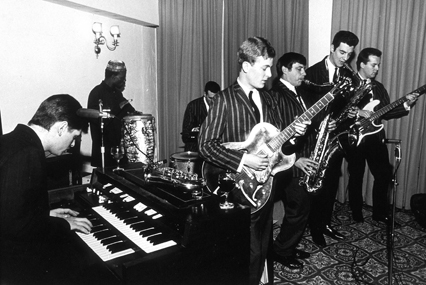
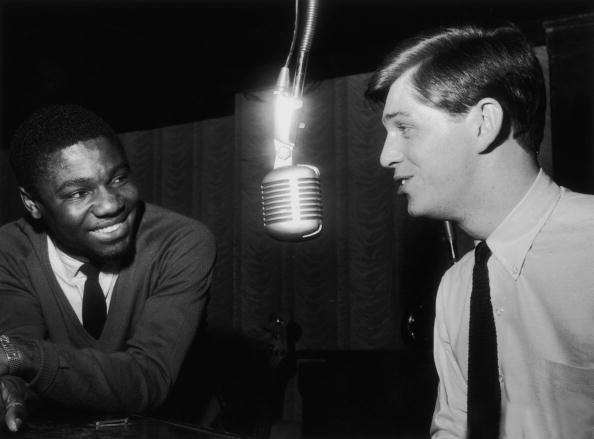
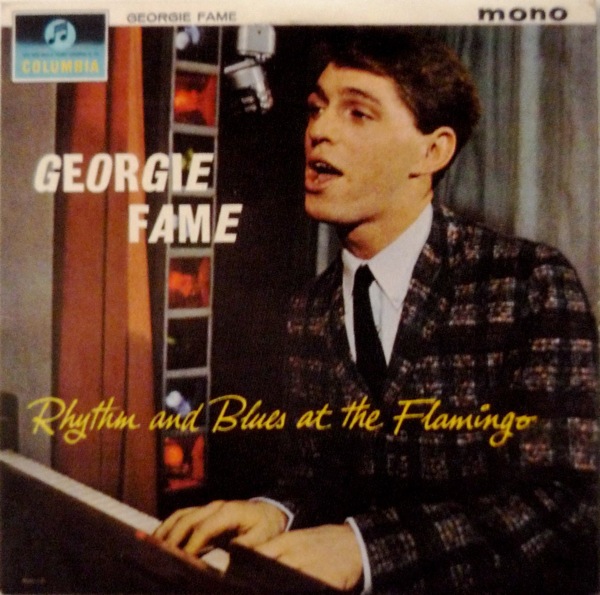
Larry Parnes, considering himself an ‘impresario’ and known to many as ‘Mr Parnes, Shillings and Pence’, started to manage other singers and after the success of Steele insisted on creating cartoonish pseudonyms, thus Reg Smith became Marty Wilde, Ronald Wycherley became Billy Fury and Clive Powell became Georgie Fame. Joe Brown, however rejected his Parnes’ name of Elmer Twitch (not surprisingly) and solely, it seems, had a music career with the name with which he was born.

Billy Fury and Larry Parnes

Billy Fury and Larry Parnes

Joe Brown

Joe Brown

Mr Parnes Shillings and Pence

Mr Parnes Shillings and Pence

Georgie Fame

Clive Powell aka Georgie Fame

marty-and-kim-wilde-1962

Reg Smith aka Marty Wilde and a young Kim Wilde

Roy Taylor aka Vince Eager

Roy Taylor aka Vince Eager

Larry Parnes wasn’t known as the ‘beat svengali’ for nothing, and his relationship with his proteges was ‘fatherly’ at the very least. Vince Eager at one point was wondering why he hadn’t received any record royalties:

“You’re not entitled to any,” Larry Parnes told him. “But it says in my contract that I am,” Eager protested. “It also says I have power of attorney over you, and I’ve decided you’re not getting any,” Parnes replied.

Parnes’ power in the music business swiftly declined with the rise of the Beatles (indeed he rejected them as a backing group for Billy Fury at one point) and, always happier with family entertainment, he went on to produce theatre shows. However the mid to late fifties was an incredibly exciting and creative time for British music and the attraction of rock ‘n’ roll brought talented (and, to be fair, not so talented) teenagers from all over the country to try their hand at a new musical fashion.

It seemed, at last, that anyone from any backgrould could make it. Only Punk, perhaps, echoed the musical ‘can do’ atmosphere of this period, just two decades later.

Frith Street in 1956, known as Froth Street in the heyday of the coffee bars

Frith Street in 1956, known as Froth Street in the heyday of the coffee bars

Leon Bell and the Bell Cats and some hand-jiving kittens

Leon Bell and the Bell Cats and some hand-jiving kittens

Doing what teenagers do best, hanging around in Soho

Doing what teenagers do best, hanging around. In Soho

The skiffle group City Ramblers in 1955

The skiffle group City Ramblers in 1955

Bill Kent entertaining the ladies at the 2 I's coffee bar

Bill Kent entertaining the ladies at the 2 I's coffee bar

It’s now over fifty years since the heyday of the 2 I’s coffee bar in Old Compton Street. A lot of the Soho cafes, like everywhere else, are either closing down or becoming part of the ubiquitous Starbucks chain. Starbucks, of course, branched last year and started their own record label featuring cutting edge artists such as Carly Simon and James Taylor.

The ubiquitous coffee chain also signed Paul McCartney, who fifty years ago was inspired by the skiffle boom created by the Soho Coffee shops to join John Lennon’s skiffle band The Quarrymen and we all know what happened to them.

The Quarrymen in 1958

The Quarrymen in 1958

A long way from the Moka coffee bar

A long way from the Moka coffee bar and Gina Lollobrigida

If you’ve only heard the novelty songs of Donegan, you will be surprised by his version of Frankie and Johnny – his voice, by the end of the song, ends up almost going insane. It was one of John Peel’s all time favourite songs if I’m not mistaken (in fact I know it was because he told me). I have also included the Peter Sellers sketch which includes ,what is apparently, an extremely accurate impression of Larry Parnes. It’s also very funny and written by Denis Norden and Frank Muir.
Anybody know what happened to the skiffle guitarist and ladies man Bill Kent?
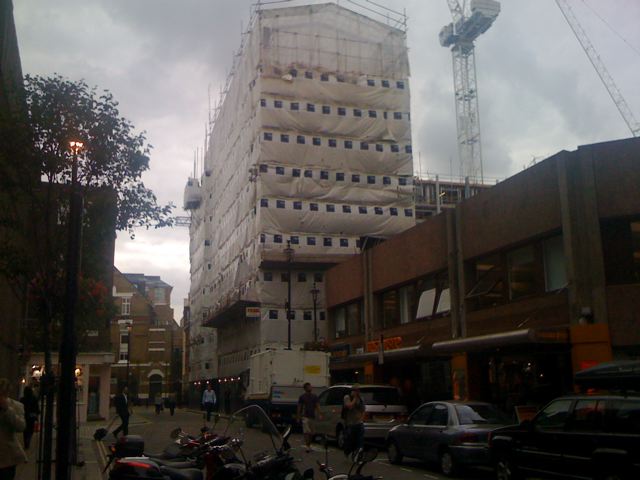
The 2i's today, November '09

The 2i's today, November '09


Lonnie Donegan – Frankie And Johnny
Lonnie Donegan – Putting On The Style
The Quarrymen – That’ll Be The Day
Peter Sellers – So Little Time
Share