Posts Tagged ‘sex’

The Murder of Ali Fahmy At The Savoy Hotel

Thursday, November 6th, 2008

“What have I done, my dear! What have I done!”


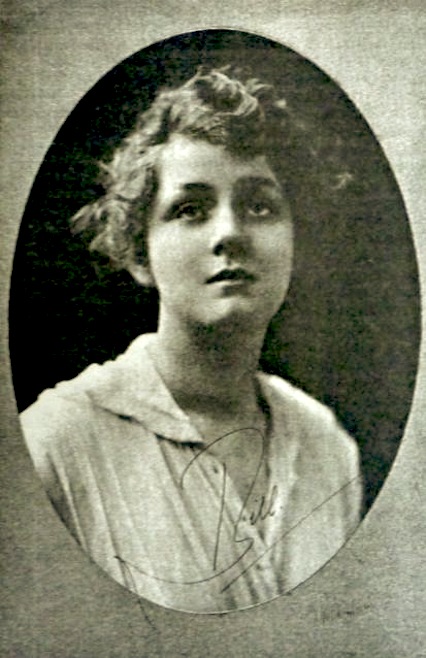
marguerite-fahmy-signed

Marguerite Fahmy

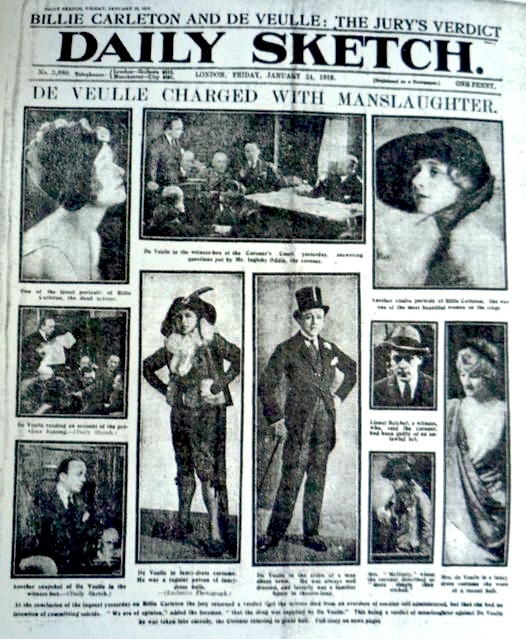
The two court cases were over seventy years apart and the LA suburb of Brentwood is a long way from the relative sophistication of London’s Savoy Hotel in the 1920s but when OJ Simpson was infamously acquitted in 1995, despite seemingly overwhelming evidence to the contrary, the shocked reaction around the world would not have been dissimilar to when Marguerite Fahmy was sensationally found ‘not guilty’ of the internationally reported murder of her Egyptian playboy husband at the hotel in 1923.   

The Savoy Hotel in 1923

The Savoy Hotel had opened in 1889, and had been no stranger to scandal –  it was at Oscar Wilde’s infamous trial where it came to light that he had entertained a succession of rent-boys at the hotel’s room 361. After Wilde had been arrested for gross indecency the presiding magistrate said “I know nothing about the Savoy, but I must say that in my view chicken and salad for two at sixteen shillings is very high. I am afraid I shall never supper there myself.” 

However it was still the place to stay for celebrities and royalty visiting London. In 1923 the hotel was still seen as one of the finest in the world and in that year, amongst others, Walter Hagen, Fred and Adele Astaire and the opera singer Luisa Tetrazzini (as in chicken) had all stayed there.        

Walter Hagen on the roof of the Savoy


Fred and Adele Astaire

A typical dismal drizzly April in London that year had only been brightened by the wedding of Lady Elizabeth Bowes-Lyon to the Duke of York, Prince Albert – known as ‘Bertie’ to his family and close friends. The house band at the Savoy Hotel – The Savoy Havana Band – made its debut on the BBC on 13th April 1923, not least because the BBC at the time was next door and shared its generator with the hotel.         

A few weeks later on the morning of Sunday 1 July 1923 a limousine drove into Savoy Court and the Hotel doorman helped out a couple who were known to the hotel as the Prince and Princess Fahmy. They were accompanied by the Prince’s private secretary, Mr Said Enani. Accurately Prince Fahmy wasn’t really a prince but he did little to discourage the use of the title when away from Egypt.

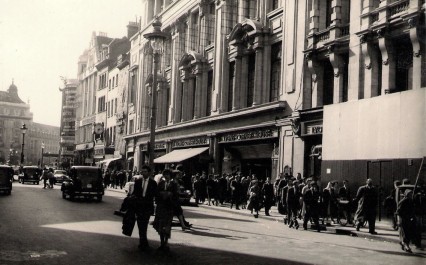
Savoy Court – the only road in Britain where drivers are required to drive on the right.

The 22 year Egyptian had met his bride to be, a woman ten years his senior, in Paris the year before -incidentally the year that Egypt was granted independence, if not overall control, by the British Government. To many people Marguerite was seen, at best, as a flirtatious gold-digger and more in love with his not inconsiderable fortune than the man himself. They had married in Egypt, first by a civil ceremony on 26th December and then followed by a Muslim wedding in January 1923 where Madame Fahmy, modestly veiled, proclaimed in Arabic ‘There is one God and Mohammed is His Prophet’. 

couple-in-egypt

Mr and Mrs Fahmy in Egypt

marguerite-in-veil
After a few days in London, which was experiencing a heatwave, Marguerite Fahmy summoned the Savoy’s doctor – she was suffering badly from external haemorrhoids. She alleged to Dr Gordon, while he was treating her, that her husband had ‘torn her by unnatural intercourse’ and was ‘always pestering her’ for this kind of sex. Already thinking about possible future divorce proceedings she repeatedly asked the doctor for ‘a certificate as to her physical condition to negative the suggestion of her husband that she had made up a story’. The doctor, although respectful, ignored her request.

On the 9th July the couple went to Daly’s Theatre on Cranbourne Street off Leicester Square (where the Vue West End cinema now stands) to see, with hindsight the darkly ironic ‘The Merry Widow’. It had been an incredibly hot day and you can only imagine how uncomfortably warm the theatre must have been in those pre-air-conditioned days (although as far as a lot of the West End is concerned we’re still in those days). Not the ideal conditions for someone suffering from piles I would imagine. The main performers in Lehar’s popular operetta were the 22 year old Evelyn Laye and the Danish matinee idol Carl Brisson.

carl-brisson

Carl Brisson

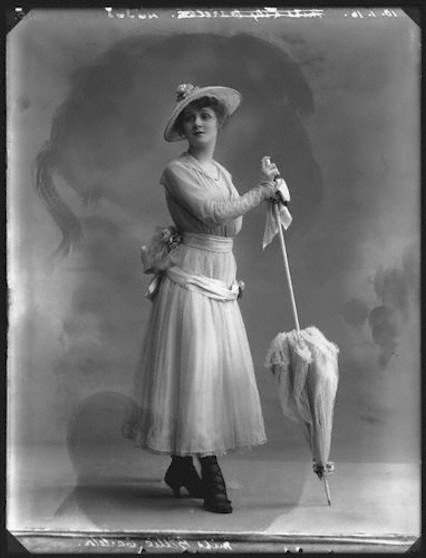
evelyn-laye

The beautiful Evelyn Laye


Daly's Theatre

The couple returned to the Savoy after the theatre for a late supper, however the meal was disrupted by a huge argument which had recently become almost a daily occurrence. Ali had even appeared in public with scratches on his face and Marguerite had been seen with dark bruises on her face ill-disguised with powder and makeup. The row this time degenerated to such an extent that Marguerite picked up a wine bottle and shouted in French ‘You shut up or I’ll smash this over your head.’ Ali replied ‘If you do, I’ll do the same to you.’ They eventually calmed down, not without the help of the head-waiter, and went to the ballroom to listen to the Savoy Havana Band. The house band no doubt would have been playing at one point  Yes, We Have No Bananas or perhaps Ain’t We Got Fun both big hits that year. It wasn’t long before Marguerite, after refusing the offer of a dance with her husband, retired to her room.

Mr Said Enani, as a witness in court a few weeks later, said that Mr Fahmy, in full evening dress, had decided to take a cab in the direction of Piccadilly even though the hot balmy weather had now turned into one of the worse thunderstorms in living memory. When asked the reason why he went, he said he did not know. Although we can perhaps presume that Ali was either visiting an unlicensed nightclub or on the search for either a male or female prostitute both of which frequented the area in high numbers around that part of the West End.          

At around 2.00am the hotel’s night porter passed the door to the Fahmy’s suite but heard a low whistle and looking back saw Ali Fahmy bending down apparently whistling for Marguerite’s little dog that had been following the night porter down the corridor. After continuing on his way for just three yards he suddenly heard three shots fired in quick succession.

He ran back and saw Marguerite throw down a black handgun and also saw Ali slumped against the wall bleeding profusely from a wound on his temple from which splinger of bone and brain tissue protruded. ‘Qu’est-ce que j’ai fait, mon cher?’ (what have I done, my dear?’) Marguerite kept saying over and over again.

sir-edward-marshall-hall-kc-portrait

Sir Edward Marshall Hall - The Great Defender

Marshall Hall was almost 65 at the time of Marguerite’s trial and was a household name. He was six feet three, handsome for his age, and a commanding presence in the courtroom. He was commonly known, after being responsible for several famous acquittals, as ‘The Great Defender’. Marshall Hall’s final speech to the jury in defence of Marguerite, or Madame Fahmy as the press were now calling her, slowly became a character assassination of her dead husband. he portrayed him as a monster of Eastern amoral bisexual depravity. (Not too) subtly Hall accused both Prince Fahmy and his private secretary of being homosexuals.

Ali Fahmy

The public gallery consisted of many young women some of whom were noted to be barely eighteen. Marshall Hall looked up to the gallery saying ‘if women choose to come here to hear this case, they must take the consequences’. None of them left. Meanwhile he turned the attack on Ali to sodomy. Fahmy, said Hall, ‘developed abnormal tendencies and he never treated Madame normally’ Asking them to disregard the fact that the victim was younger than his wife. ‘Yes, he was only 23 years old,’ he told them. ‘But he was given to a life of debauchery and was obsessed with his sexual prowess.’ He went on to remind them that, as an Oriental man, his wife to him was no more than a belonging and that however much he may have acquired the outward signs of urbanity and sophistication, he was forever an Oriental under the skin.


When Marguerite took the stand, she was encouraged by the Great Defender to describe her life as a Muslim bride and to a lot of observers this was when the case turned her way. She testified at one point how she had been sitting ‘in a state of undress in which her modesty would have forbidden her facing even her maid’, she had noticed a strange noise and she pulled aside the hangings that screened an alcove and ’saw crouching there, where he could see every move she made, one of her husband’s numerous ugly, black, half-civilized manservants, who obeyed like slaves his every word’. She screamed for help, but when her husband, appeared from an adjoining room he only, laughed, saying that “He is nobody. He does not count. But he has the right to come here or anywhere you may go and tell me what you are doing.”

It was like a scene from Rudolph Valentino’s The Sheik, the extraordinarily popular film released the year before, and the women in the gallery were treating it as such.

Before he summed up, the judge, referring to the public gallery said, ‘These things are horrible; they are disgusting. How anyone could listen to these things who is not bound to listen to them passes comprehension.’ However he had been swayed by Marshall Hall’s defence, that pandered to the prejudices of the tie, and during the summing up endorsed Marshall Hall by saying ‘We in this country put our women on a pedestal: in Egypt they have not the same views…’

The jury, after less than an hour’s consideration, announced ‘not guilty’ to both the charges of murder and of manslaughter, and Madame Fahmy was discharged and was now a free woman.

The prosecution was refused by the judge, seemingly in awe as much as anyone else to the Great Defender, to cross-examine Marguerite ‘as to whether or not she had lived an immoral life’, to show that she was ‘a woman of the world, well able to look after herself’.

If she had been cross-examined properly the jury would have found out that not only had Marguerite been a teenage common prostitute in Bordeaux and in Paris and had an illegitimate daughter when she was just fifteen, but she had also become a trained high-class courtesan (it was said that she always spoke in a rather stilted French because of elocution lessons). Not only that but Marguerite’s husband was not alone in having inclinations towards the same sex: it was found out by a private detective hired by the prosecution that it was well known in Paris that Madame Fahmy “is addicted, or was addicted, to committing certain offences with other women and it would seem that there is nothing that goes on in such surroundings as she has been moving in Paris that she would not be quite well acquainted with…”


The world’s press reported the case with undisguised glee, mostly portraying Mardame Fahmy as less than innocent in more ways than one. The French newspapers concentrated on the fact that the jury considered the case as if a crime passionnel defence was allowed in English law.


Marguerite Fahmy after the trial

Marguerite Fahmy after the trial

After the verdict Marguerite soon left for Paris where she found out that she had no claim to her late husband’s fortune as he had left no will. After a failed, and slightly ludicrous plot where she pretended that she had been pregnant and subsequently borne a son (who would have been entitled to his father’s fortune). She was now almost a laughing stock in Parisian society and became relatively a recluse. She died on 2 January 1971 in Paris. She never remarried.

A big debt to this post is Andrew Rose’s excellent book about the notorious murder entitled Scandal at the Savoy originally published in 1991. The author has copies still available and can be contacted at andrewroseauthor@googlemail.com.

Billy Jones – Yes, We Have No Bananas!

The Savoy Havana Band - I’m Gonna Bring My Girl a Watermelon Tonight

Louis Armstrong, King Oliver and Bessie Smith – Sugarfoot Stomp (Dippermouth Blues)

Jeanette MacDonald – Merry Widow Waltz 

Paul Whiteman’s Orchestra – Happy Feet

Erik Satie – Gnossiennes No. 1

Benson Orchestra of Chicago – Ain’t We Got Fun

  • Share/Save/Bookmark

Mayfair, the Duchess of Argyll and the Headless Man polaroids

Sunday, October 5th, 2008

“She is a highly sexed woman who has ceased to be satisfied with normal sexual activities.”

Margaret, Duchess of Argyll

Margaret, Duchess of Argyll

48 Upper Grosvenor Street was once dubbed by John Paul Getty as “Number One, London” and it was the Mayfair house where one of the most celebrated sex scandals of the Sixties took place.

A series of Polaroid photographs were used as evidence in the bitter and acrimonious divorce case between the Duke and Duchess of Argyll in 1963. They featured Margaret the Duchess, a former debutante of the year, in her Art Deco-style bathroom at her Upper Grosvenor Street home dressed in nothing but her signature three-strand pearl necklace. More shockingly they showed her performing fellatio on a naked man whose identity was concealed because his head was not captured within the frame. Other polaroid photographs showed a man masturbating for the camera in the same bathroom.

The press, overexcited with the ongoing Profumo affair, started to question who exactly was the headless man? There were very strong rumours that it might be be a cabinet minister or even a famous film star.

Number One, London

Number One, London

Duke and Duchess of Argyll not long after their wedding

Duke and Duchess of Argyll not long after their wedding

The Duke and the Duchess, both divorcees, had met on a blind date in 1950 and married in 1951 at Caxton Hall registry office. The marriage quickly crumbled however and the Duchess later admitted that she was having affairs by 1954 and the Duke filed for divorce in 1959 after finding his wife’s salacious diaries and the compromising polaroids. After four years of legal wrangling the case reached the court in 1962 but it wasn’t until May 1963 that the judge Lord Wheatley issued his damning verdict and in a four-and-a-half hour judgement, read out:

“She is a highly sexed woman who has ceased to be satisfied with normal sexual activities and has started to indulge in disgusting sexual activities to gratify a debased sexual appetite. A completely promiscuous woman whose sexual appetite could only be satisfied by a number of men, whose promiscuity had extended to perversion and whose attitude to the sanctity of marriage was what moderns would call enlightened, but which in plain language was wholly immoral.”

The press had a field day and the Duchess’s reputation was ruined, not only because of the polaroid photos, but that she was accused of sleeping with eighty eight men including two cabinet ministers and two members of the royal family.

It was said that an accidental fall, forty feet down a lift-shaft during the war, left her not only with a lack of taste and smell but with a voracious sexual appetite bordering on nymphomania.

The Duchess in July 1963

The Duchess in July 1963

Within two weeks of the judge Wheatley’s verdict on June 5 John Profumo resigned after admitting that he had slept with Christine Keeler. The Duke and Duchess and the headless man photos were for a short while almost forgotten. However, at a stormy cabinet meeting on June 20, the Defence Secretary Duncan Sandys (pronounced Sands), incidentally the son-in-law of Winston Churchill, confessed that he was rumoured to be the headless man.

Sandys offered to resign, but he was dissuaded by Prime Minister Macmillian who, because of the Profumo affair, was frightened of even more scandal for the Government. Lord Denning, who had already been commissioned to investigate the Profumo scandal, was also asked to investigate the identity of the headless lover as part of the remit.

Lord Justice Denning on the day his report was published

Lord Justice Denning on the day his report was published

Duncan Sandys

Duncan Sandys

Douglas Fairbanks Jnr around the time of the affair

Douglas Fairbanks Jnr around the time of the affair

There were four polaroids of a man in different states of arousal each with handwritten captions: “before”, “thinking of you”, “during – oh”, and “finished”. Denning knew that if he could match the handwriting, he would find his man. He cunningly invited the five key suspects – Sandys, the American actor Douglas Fairbanks Jnr, American businessman John Cohane, Peter Combe, an ex-press officer at the Savoy, and Sigismund von Braun, the diplomat brother of the Nazi scientist Werner von Braun – to the Treasury and asked for their help in a “very delicate matter”.

On arriving they all signed the visitor’s register and their handwriting was analysed by a graphologist. The result proved conclusive. Although Denning didn’t include the result in his report the headless man was identified by the handwriting expert as the actor Douglas Fairbanks Jr.

Duncan Sandys, much to his relief, appeared to be in the clear, but thirty seven years later in the year 2000 a Channel 4 documentary about the case featured a man called Paul Vaughan, a friend of the Duchess’s. He reported that she had once said to him;

“Of course, sweetie, the only Polaroid camera in the country at this time had been lent to the Ministry of Defence.”

The programme analysed the film and found that it was taken in 1957 (Sandys was the Defence Minister at this time) and concluded with this new evidence that there had been two men in the photos and that Duncan Sandys had been one of them.

Although I admit that I haven’t seen the documentary, but in 1957 Polaroid cameras had been selling commercially for eight years and Polaroid had actually sold their millionth camera the year before in 1956. It therefore defies credibility that the Ministry of Defence had had the only Polaroid camera in the entire country. So it seems to me that the documentary’s conclusion is on very shaky ground and perhaps Sandys was completely innocent after all.

Early Polaraoid Camera from 1949

Early Polaraoid Camera from 1949

Polaroid Camera model 95B - probably the type used in the Duchess's bedroom

Polaroid Camera model 95B - probably the type used in the Duchess's bedroom

The Duchess’s reputation, of course, was ruined after the divorce case and ensuing scandal, but she was also ruined financially and eventually had to sell her house in Upper Grosvenor Street. She died in a Pimlico nursing home in July 1993 and was buried next to her first husband, the amateur American golfer Charles Sweeney.

Duchess of Argyll at her house in Upper Grosvenor Street

Duchess of Argyll at her house in Upper Grosvenor Street

Incidentally, before she died the duchess wrote:

“I had wealth, I had good looks. As a young woman I had been constantly photographed, written about, flattered, admired, included in the Ten Best-Dressed Women in the World list, and mentioned by Cole Porter in the words of his hit song ‘You’re the Top’.”

She was indeed mentioned in the Porter’s classic song, under her name from her first marriage to Charles Sweeny, but the lyrics were from PG Wodehouse’s slightly rewritten and quietly forgotten British version of the song which changed Porter’s lyrics from:

You’re the nimble tread of the feet of Fred Astaire
You’re an O’Neill drama,
You’re Whistler’s mama!
You’re camembert.

to

You’re Mussolini
You’re Mrs Sweeny
You’re Camembert.

Mussolini with his pet lion cub Ras

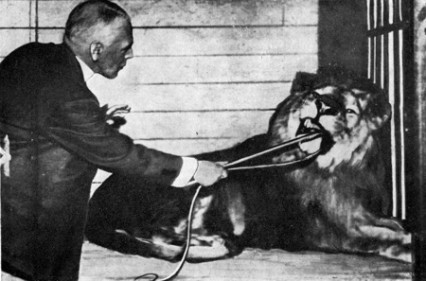
Mussolini with his pet lion cub Ras

PG Wodehouse, although one of the wittiest writers ever, was always slightly politically suspect especially when it came to accidentally appeasing fascists. He didn’t really do himself any favours in that respect when he rhymed Mrs Sweeny with Mussolini in his version of You’re The Top.

TheLondon transfer of Porter’s musical Anything Goes opened on June 14, 1935 and it was only three months later that the Italian dictator, who had been in power since 1922, ordered the bombing and the use of poisonous mustard-gas in the Italian invasion of Ethiopia.

If Wodehouse thought Mussolini was the top, God only knows what he considered the bottom. There again perhaps it was just playful irony from Wodehouse and he just enjoyed comparing Mrs Sweeny with Mussolini.

Ethel Merman – You’re The Top
Ethel Merman – Blow, Gabriel, Blow
Frank Sinatra – Anything Goes
Eileen Rodgers – I Get A Kick Out Of You
Divine Comedy – A Lady Of A Certain Age

  • Share/Save/Bookmark

The Kings Road, the misogynist John Osborne and the women in his life

Thursday, July 10th, 2008

“Will you marry me? It’s risky, but you’ll get fucked regularly”.

The angry young playwright in Chelsea 1958

The angry young playwright in Chelsea 1958

Four months before the Suez crisis, the moment in history when a begrudging, drizzly and grey Britain belatedly realised it wasn’t a super-power any more, the newly re-opened Royal Court Theatre, situated on the east side of Sloane Square in Chelsea, premiered the first play by a 26 year old actor called John Osborne.

look-back-in-anger-programme1

Look Back In Anger was written in seventeen days while sitting in a deckchair on Morecambe pier . The legend is, of course, that Osborne’s play was an immediate success and in a flash British theatre was changed forever. Replaced by plays set in drab working working class northern bed-sits, the posh drawing-room dramas from playrights like Terrence Rattigan and Noel Coward, were seemingly banished overnight.

Indeed on the first night of Look Back In Anger the first glance of Alison Porter’s ironing board on stage drew actual loud gasps from the audience. Rattigan himself, although persuaded not to leave at the interval by a friend, said on leaving the theatre,
“I think the writer is trying to say: ‘Look how unlike Terence Rattigan I am, Ma!”.
Terence Rattigan in 1955

Terence Rattigan in 1955

In actuality, after the first night the Guardian wrote: ”The author and actors do not persuade us that they ’speak for’ a new generation.” The London Evening Standard called the play “a self-pitying snivel”.

The next day the director of the play Tony Richardson and Osborne sat in the little coffee shop next to the Royal Court theatre utterly depressed. Richardson broke the silence, and said:

“But what on earth did you expect? You didn’t expect them to like it, did you?”

Although the play was generally initially dismissed by most of the critics, a prescient 39 year old Kenneth Tynan wrote in the Observer -

“All the qualities are there, qualities one had despaired of ever seeing on the stage … I doubt if I could love anyone who did not wish to see Look Back in Anger.”

Kenneth Tynan with Claire Bloom

Kenneth Tynan with Claire Bloom

Kenneth Haigh and Osborne 1956

Kenneth Haigh and Osborne 1956

Kings Road in 1958

Kings Road in 1958

Kenneth Haigh and Mary Ure in the last scene of Look Back In Anger

Kenneth Haigh and Mary Ure in the last scene of Look Back In Anger

Tony Richardson and Vanessa Redgrave

Tony Richardson and Vanessa Redgrave

‘Anger’, as luvvies are apt to call the play, initially took very little money and the production was seen pretty much as a miserable failure. However, a few weeks into the run, the BBC decided to broadcast a short excerpt of the play one evening. The listeners liked what they heard, decided to go and see the play for themselves and takings immediately doubled at the box office. The effect snowballed and the play eventually transferred to the West End, subsequently to Broadway and was made into a film in 1958 starring Richard Burton. It certainly wasn’t overnight but Osborne had now become a very famous angry young man indeed.

Richard Burton and Claire Bloom during the making of the film

Richard Burton and Claire Bloom during the making of the film

Richard Burton at the opening night of the film 1958

Richard Burton at the opening night of the film 1958

Osborne in 1971

Osborne in 1971

Osborne went on to write successful plays such as The Entertainer (starring Sir Laurence Olivier), Luther and A Patriot For Me. He also won an oscar for his adaptation of Tom Jones in 1963. He occasionally continued acting and his acting role in the 1971 film Get Carter was highly regarded and indeed was a brilliant menacing performance.

By the early seventies, however, depression and alcoholism set in. Bad reviews of his latest unfashionable plays didn’t help and were woundingly taken to heart. For instance the Financial Times’ BA Young’s review of his play Sense of Attachment which was put on in 1972 -- “This must surely be an end to his career in the theatre”.

Writers, and artists in general, are often excused character defects and bad behaviour, for the sake of their art, but the treatment Osborne dealt out to most of the women in his life (and surprisingly, considering his behaviour, there were a lot of them with five wives and numerous affairs) was often extremely vile and misogynistic.

He left his first wife shortly before the opening of Look Back In Anger, and subsequently married Mary Ure the leading actress in the play and the film. They lived in a house in Woodfall Street just off the Kings Road a few hundred yards from The Royal Court Theatre. It was a marriage that would only last five years and his love life was, by the early sixties, extremely complicated. He was on holiday in the South of France with his mistress the beautiful flame-haired dress designer Jocelyn Rickard in 1961, while at home Mary Ure was giving birth to a son (to be fair it probably wasn’t Osborne’s). At the same time, in Italy, the journalist Penelope Gilliatt, and future mother of his daughter, received a charming marriage proposal by letter;

“will you marry me? It’s risky, but you’ll get fucked regularly”.

Osborne and his bride and leading lady Mary Ure, August 1957

Osborne and his bride and leading lady Mary Ure, August 1957

Osborne, Mary Ure, Vivien Leigh and Olivier

Osborne, Mary Ure, Vivien Leigh and Olivier

Osborne and Jill Bennett at their wedding in 1968

Osborne, the moustache and Jill Bennett at their wedding in 1968

John Osborne and Jill Bennett in 1969

John Osborne and Jill Bennett in 1969

The letter worked (one day I will understand women) and a year later he married Gilliatt with whom he had a daughter. As usual the marriage was a relatively short-lived affair, and he married the actress Jill Bennett in 1968. Again the marriage soon became unhappy and the couple, both drinking extremely heavily, ended up viciously trying to put each other down. At a party she once shouted;

“Look at him, the poofter can’t even get it up.”

Jill Bennett committed suicide in 1990, two years after their divorce. Osborne decided to add a spiteful extra chapter to his memoirs -- expressing pity that he hadn’t been able to look into her open coffin and “drop a good, large mess in her eye”. Peggy Lee’s ‘Is That All There Is?’ was played at her funeral.

When Gilliatt also fell in to irreversible alcoholism, their daughter Nolan, who had been brought up in New York with her mother, came to live with Osborne and his fifth wife Helen, then both living in Kent. It was a chance for him to make amends for his own unhappy childhood (his father died of TB when Osborne was 10, for which, some reason, he always blamed his mother) but after just three years Osborne threw Nolan out of his house, removing her from school for good measure. She was just seventeen. Her only crime seems to have been typical teenage sullen behaviour and a lack of interest in her father’s hard-drinking thespian friends. He once shouted at her;

“There is not one of them who is not worth a dozen low lifes like you.”

She went to stay with the family of a schoolfriend and Osborne never saw her again. “Nolan’s birthday,” he wrote in his diary when she turned 22, “God rot her.”

Likewise when his mother died in 1993, he wrote an article for the Sunday Times which included a first line, ‘A year in which my mother died can’t be all bad.’

Osborne, who by this time had long left Chelsea’s Kings Road and started to act the country gent in Shropshire with his fifth wife Helen, died on Christmas Eve in 1994, 12 days after his 65th birthday. For once their marriage was a relatively devoted and private relationship. The last words that he wrote, found by his wife scrawled on a cigarette pack beside his deathbed in the hospital, were, “Sorry, I have sinned.”

Osborne more sleepy than angry towards the end of his life

  • Share/Save/Bookmark

Soho and the fall of the Dirty Squad

Thursday, June 26th, 2008

“Corruption on a scale that beggars description.”

A Soho bookshop

That there was corruption in Soho in the late sixties and early seventies was an open secret amongst journalists, lawyers and the police themselves; although not many vaguely knew the extent of it.
While the Soho porn industry was steadily proliferating, seemingly untouched, there was an extraordinary ferocious police assault against, what they thought as, politically subversive ‘obscenity’ and apologists for the ‘alternative society’.
People looking at the Lennon exhibition at Eugene Schuster's London gallery in 1970

People looking at the Lennon exhibition at Eugene Schuster's London Art's gallery in 1970

A police at duty outside Lennon's Bag One exhibition at London Arts gallery 1970

A police at duty outside Lennon's Bag One exhibition at London Arts gallery 1970

In 1970 Eugene Schuster’s London Arts Gallery was raided by the police. The gallery was closed down and Schuster was charged under the Obscene Publications Act. This wasn’t particularly abnormal at the time but this particular closure garnered an extraordinary amount of publicity because the show was entitled The Bag One exhibition -- featuring 14 ‘intimate and erotic’ lithographs by John Lennon that depicted himself and his wife, Yoko Ono, in various sexual poses.
Soon after the closure the Director of Public Prosecutions received a letter from a member of the public, a Mr PFC Fuller. The letter warned that if the court case went ahead art collections throughout the country could potentially be in trouble, including even the Queen’s. In his letter Fuller wrote;
“I understand that HM the Queen has some highly erotic work by Fragonard”.


Whether it was Mr Fuller’s letter that changed the direction of the proscecution we don’t know, but at the last minute, the police decided to file charges against Schuster under an obscure 19th Century law instead of the Obscene Publications Act. Not surprisingly on April 27th 1970 the case was thrown out by the court under a technicality.
The cover of the infamous schoolkids issue of Oz

The cover of the infamous schoolkids issue of Oz

In the same year as the gallery closure and after it was accused of losing touch with their younger readers, the satirical magazine Oz reacted by inviting actual schoolchildren to edit a forthcoming May 1970 issue -- quickly becoming known as the Schoolkids Oz. The magazine’s offices had already been raided several times by the The Obscene Publications Squad (known colloquially at the time as The Dirty Squad) but the bringing together of schoolchildren, and what some considered obscene material, soon led to arrests of Oz’s actual editors and subsequently the infamous Oz obscenity trial in 1971. The magazine’s defence lawyer, the late John Mortimer QC announced at the opening of the trial
“[this] case stands at the crossroads of our liberty, at the boundaries of our freedom to think and draw and write what we please”.
However according to the prosecution at the trial the magazine;
“dealt with homosexuality, lesbianism, sadism, perverted sexual practices and drug taking”.
Richard Neville, Jim Anderson and Felix Dennis

Richard Neville, Jim Anderson and Felix Dennis

The wig-wearing Oz editors celebrating the outcome of the trial in November 1971

The wig-wearing Oz editors celebrating the quashing of their conviction in November 1971

At the conclusion of what became the longest obscenity trial in British legal history, the “Oz Three” editors, Richard Neville, Jim Anderson and Felix Dennis were found guilty and Neville and Anderson were sentenced to an incredible 15 months in prison. Dennis was given a lesser sentence because the judge, Justice Michael Argyle, considered that Dennis was “very much less intelligent” than Neville and Anderson.
Soon after the verdicts were announced the three men were taken to prison and had their heads shaved. It was an act that caused an even greater stir on top of the already considerable public outcry surrounding the trial and verdict.
The extremely unintelligent future multi-millionaire publishing magnate Felix Dennis

The extremely unintelligent future multi-millionaire publishing magnate Felix Dennis

A great number of people started to wonder why art gallery owners and satirical magazine editors were being arrested when there seemed to be any amount of hardcore pornography available in West End’s Soho. As a recent victim himself of the Dirty Squad, John Lennon lent his support to Oz and released Do The Oz to help their cause.
When the Oz obscenity case went to appeal -- the defendants famously appeared wearing long wigs -- it was alleged by Geoffrey Robertson, one of the defence counsels, that the lord chief justice, Lord Widgery, sent his clerk to Soho to buy the hardest porn he could find. Compared to the material with which he returned, Oz magazine paled in comparison and the original convictions were quickly quashed.
The home secretary Reginald Maudling

The home secretary Reginald Maudling

The Conservative Home Secretary, Reginald Maudling, asked Detective Chief Inspector George Fenwick, at the time in charge of the Obscene Publications Squad, exactly why the porn barons in Soho seemed to be operating with somewhere close to impunity. Fenwick explained to Maudling;

“It is an unfortunate fact of life that pornography has existed for centuries and it is unlikely that it can ever be stamped out.”

Maudling was shocked with this explanation, or what was rather a lame excuse, and he quickly initiated a major corruption inquiry. The Government and the judiciary were slowly coming to the conclusion that there was more than the odd bad apple in the Metropolitan police.

The Metropolitan Police commissioner in 1972

The Metropolitan Police commissioner in 1972

In 1972 Maudling appointed Robert Mark to be the new Commissioner of the Metropolitan police. To the old guard he was a provincial outsider. Mark had the reputation as a ‘Mr Clean’ and had nicknames such as ‘The Manchester Martinet’ and ‘The Lone Ranger from Leicester’.

In Soho at the time it was impossible not to notice the porn shops, they had proliferated greatly in the last few years, and unusually for stores at the time they were open seven days a week. The windows were filled with garish displays of soft-core magazines and books but with notices implying, often correctly, that there was a wider range of harder material to be found inside.

soho-sex-1973

soho-taboo-1973

striptease-frith-1971

Soho in the early seventies

In the same year as Mark’s appointment the Sunday People exposed a connection between James Humphreys (who openly ran two strip clubs and was one of the biggest operators of pornographic bookshops in Soho) and Commander Kenneth Drury. They had both enjoyed a luxurious two week holiday in Cyprus accompanied by their wives, all paid for, of course, by the Soho pornographer. Drury was hopelessly compromised and with concocted a story that he was in Cyprus looking for the train robber Ronnie Biggs.

James Humphries in January 1974

James Humphries in January 1974

James Humphries after his arrest, January 1974

James Humphries after his arrest, January 1974

Humphreys quickly realised the danger of appearing as a police informant and announced that Drury had set up the whole thing. After a police raid at his house a diary of Humphrey’s was found in a wall safe and it unbelievably detailed payments to seventeen different policemen. The policeman included senior policemen such as Bill Moody -- Head of the Obscene Publications Squad but also, incredibly, his superior Commander ‘Wally’ Virgo -- a man who had overall control of nine squads including the Flying, Drugs and the Porn Squad.

It was estimated that James Humphreys and his fellow porn barons were paying an extraordinary £100,000 a year to corrupt policemen to enable them to continue selling porn unimpeded. Indeed it came to light that Humphreys had been so worried that Drury’s expensive lifestyle would give everything away, he had supplied him with expensive slimming drugs and a rowing machine to keep his weight down.

Commander Kenneth Drury - the most senior policeman ever to be convicted

Commander Kenneth Drury - the most senior policeman ever to be convicted

The delicately balanced house of cards the corrupt policemen had built, soon came tumbling down. Initially there were just the usual discrete early retirements and resignations but eventually there were two major corruption trials and George Fenwick, Bill Moody, Wally Virgo and Kenneth Drury were all given between ten and fourteen years in prison in 1977. Mr Justice Mars Jones after Fenwick’s trial said:

“Thank goodness the Obscene Publications Squad had gone. I fear the damage you have done may be with us for a long time.”

After the second trial Mars-Jones said it revealed:

“corruption on a scale which beggars description.”

'See any porn constable?'...'Nope'.

'See any porn constable?'...'Nope'.

  • Share/Save/Bookmark